A separate American comparison / Boston / 1886 & 1890
A cookbook on the campaign table.
Here, the connection to voting rights is stated on the page.
Hattie A. Burr’s preface presents domestic usefulness and women’s enfranchisement as purposes of the same book. Its title page says it is in aid of named events. These establish declared purpose, not a financial return. Preface, p. iii; title page.
We consulted Michigan State University’s scan of a second-edition copy that names both events. Iowa State catalogues its parallel copy as 1890 and notes two missing pages, 65–66. We do not describe our inspected scan as the 1886 first edition, or assume every selected contribution was unchanged from it. Iowa State catalogue.
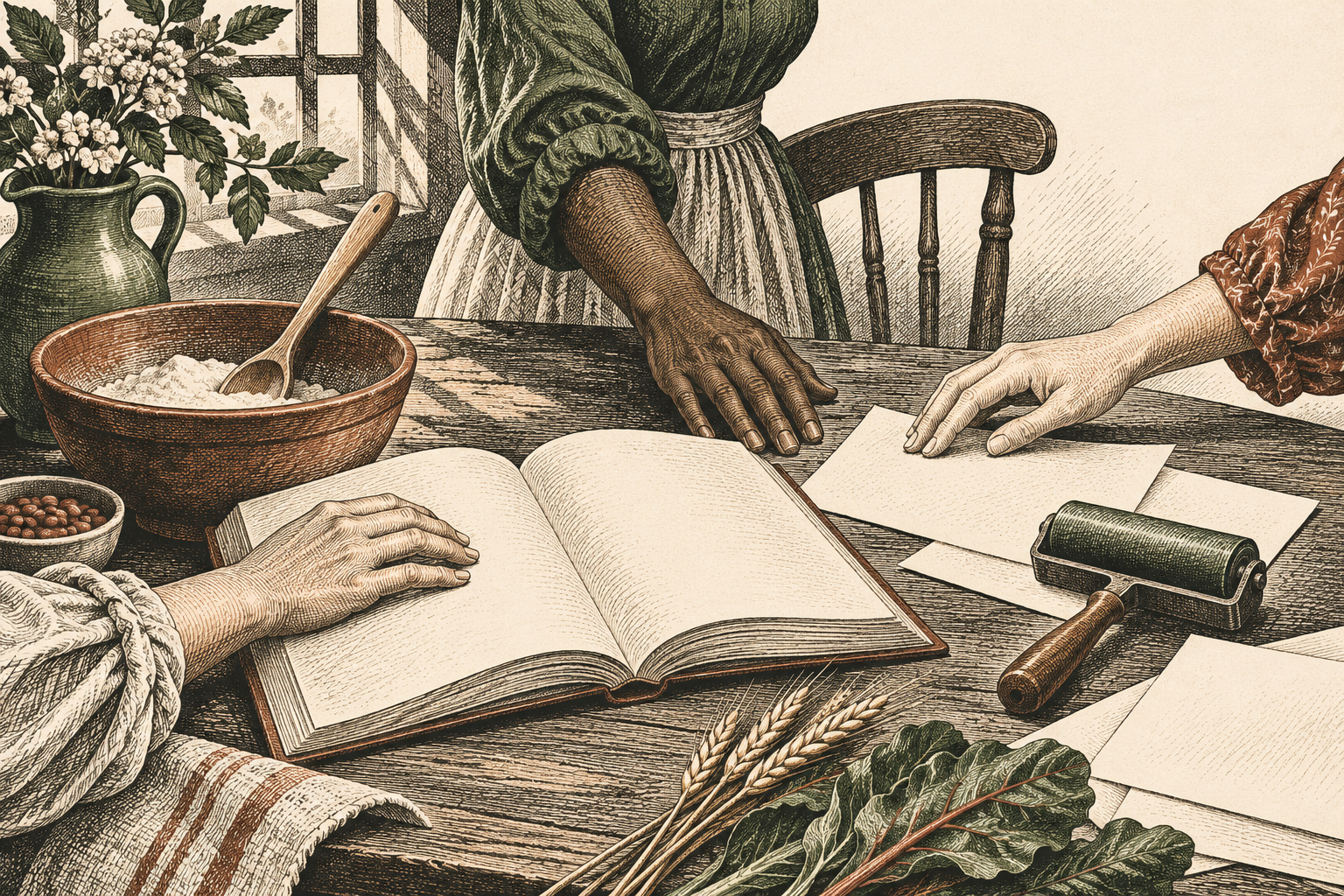
AI-generated contemporary illustrationA table for food and collective work. The anonymous figures and objects are imagined; this is not a portrait of the contributors, a documented meeting or evidence of printing practices. Image provenance.
Three selected contributors / Each connection has two sources
From a printed name to a public role.
Choose a name to follow its contribution. A recipe attribution identifies the name printed in the book; it is not proof of invention, personal preparation or sales generated.
Showing all three source trails.
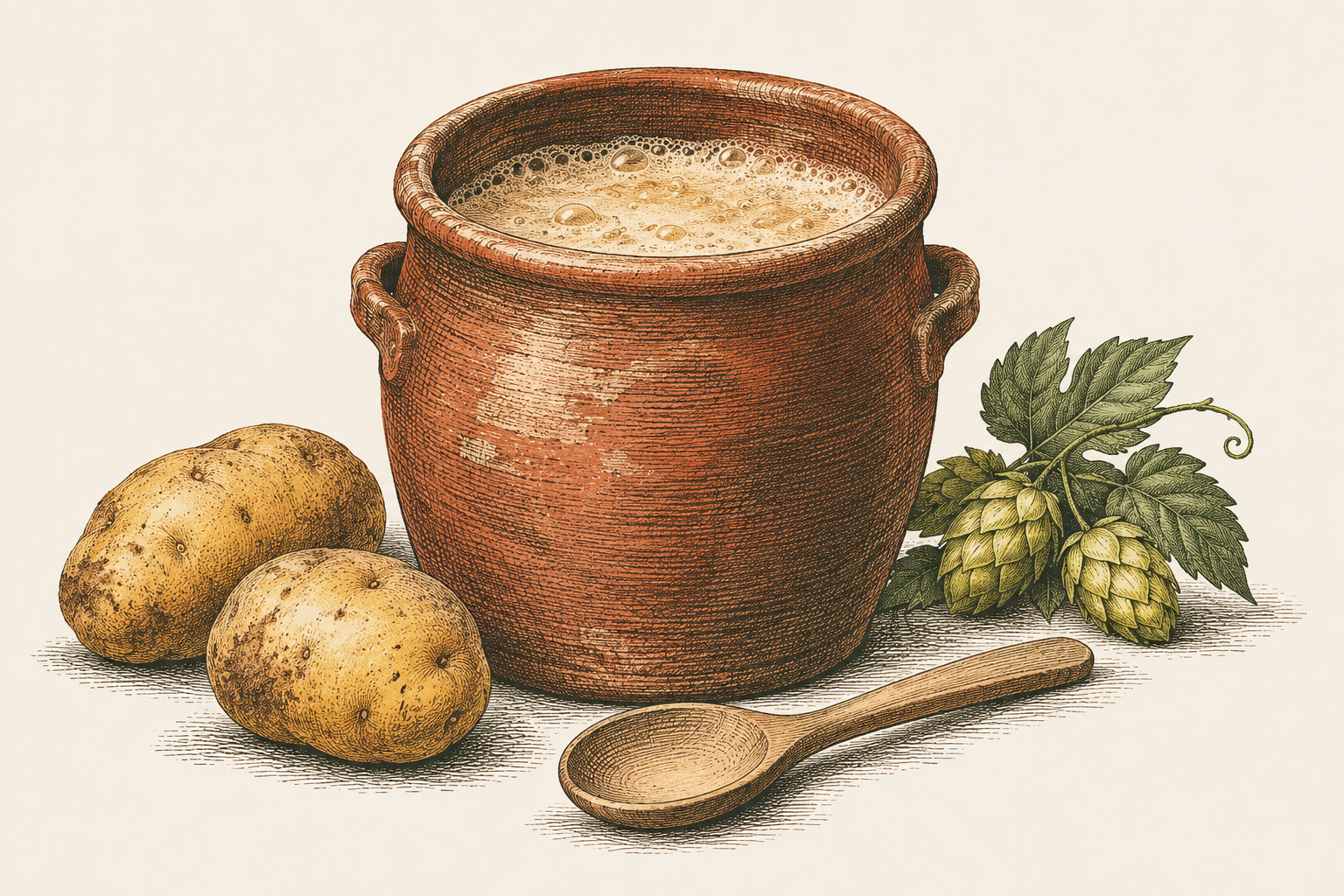
AI-generated interpretationA conceptual yeast preparation, not a documented vessel, batch or fermentation stage. About these images.
01 / Contribution
Home Made Yeast
A preparation using hops and potatoes, with two successive twenty-four-hour waits. This is elapsed waiting, not forty-eight hours of continuous labour.
Two publications connect the same named person to a culinary contribution and a suffrage organisation. The earlier officer list does not establish her office when this cookbook copy circulated. Neither source measures what her recipe earned or whom it persuaded.
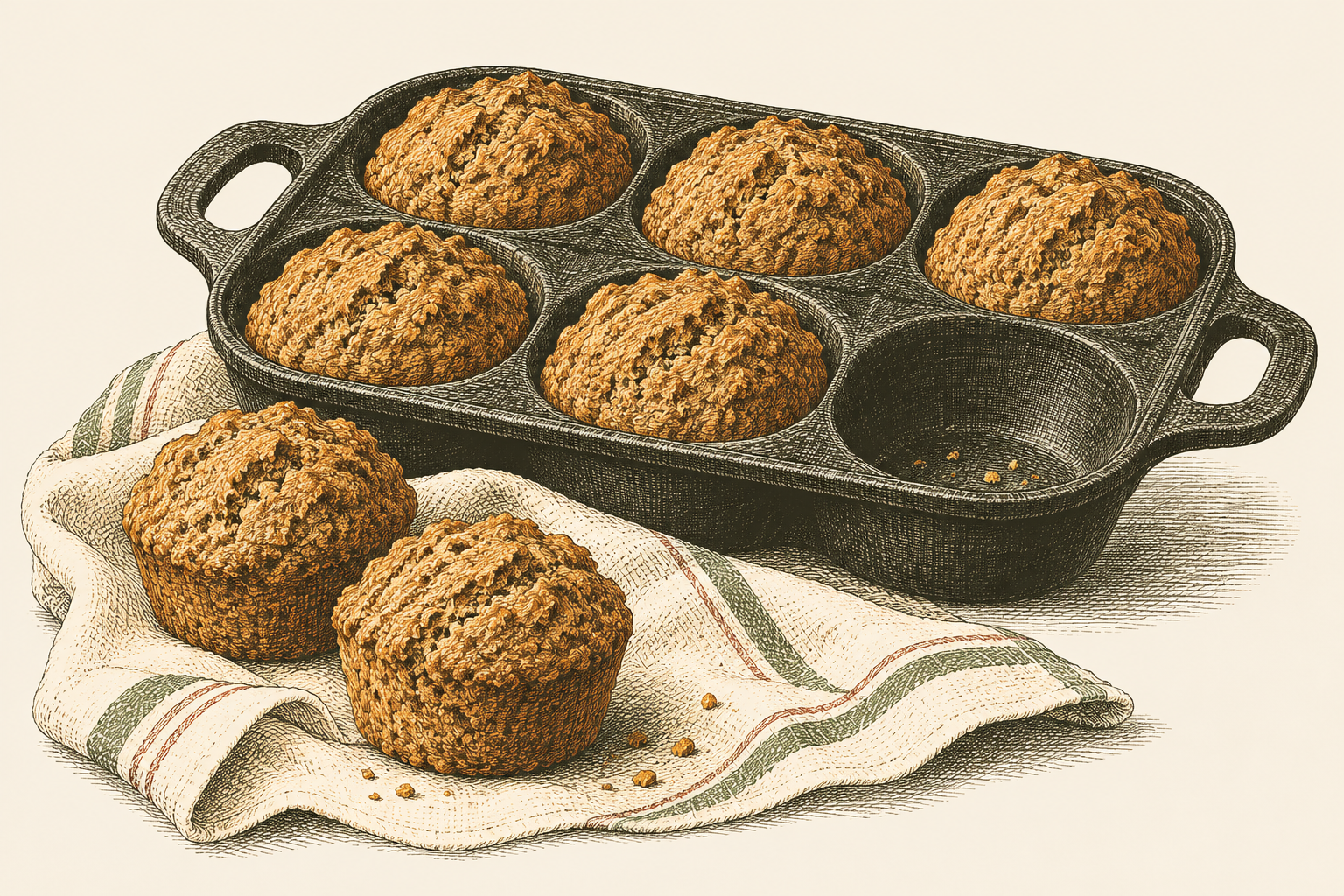
AI-generated interpretationAn imagined batch of Graham gems; pan design, number and finished appearance are interpretive. About these images.
01 / Contribution
Graham Gems
The first of several recipes with this title on p. 11 is attributed to Mary A. Livermore. It specifies heated, buttered gem pans and a hot oven.
Attribution follows the first recipe on the page. The following Graham Gems versions have other names; their ingredients and instructions belong to separate contributions. Printed attribution does not establish an observed meal or that she invented the formula.
01 / Contribution
Money, leisure & duty
Howe’s statement addresses women with sufficient money for leisure, endorses earning, and argues that duty should not depend solely on wages. This contribution is a statement, not a recipe.
Interpretation: a campaign for political rights could value unpaid service while recognising that some women possessed the money and leisure to provide it. That is a question about unequal resources for participation. It is not a finding about the income of all contributors or a universal position of the suffrage movement.
Connecting lines express documented associations, not money flows, causal effects or relative influence.
Domestic knowledge & political authority
Political rights. Domestic credentials. Whose unpaid time?
This exhibition interprets the publication as bringing practical household knowledge into a public claim to authority. Howe’s statement prevents us from treating that move as a simple release from domestic obligations.
A strategy with a social price
Jessica Derleth interprets suffrage cookery as a deliberate political tactic: activists contested exclusion by demonstrating domestic competence. Her argument also follows the race, class and gender hierarchies this tactic could preserve. Read alongside Howe’s statement, it raises our question about who could afford unpaid public service.
Press enthusiasm is evidence of reception
Derleth identifies favourable coverage of Burr’s book in The Woman’s Journal, 23 October 1886, p.339, and 6 November 1886, pp.358–359. Predictions that cookery would win supporters demonstrate an argument about persuasion; they do not count converted voters.
Scholarship & newspaper references
Jessica Derleth, “‘Kneading Politics’: Cookery and the American Woman Suffrage Movement,” Journal of the Gilded Age and Progressive Era 17(3), 2018, pp.450–474; consulted introduction pp.450–453 and political/cookbook discussion pp.461–465, especially p.463, notes110–113. Article and DOI.
The journal reports are known here through Derleth’s citations. Their original issues have not been inspected. The newspaper reports are evidence of reception through the cited scholarship, not a measure of the book’s wider readership.
This American case does not establish a connection to the British Women’s Co-operative Guild. Compare methods and questions across the exhibition; do not merge organisations, currencies or political settings.
Boston / reported event results / historical US dollars
What the fairs brought in.
The movement’s 1902 history reports results for the events named in Burr’s cookbook and a further Boston bazaar. Read the accounting labels before comparing the amounts.
Nearly this amount in gross receipts; a separate event. Printed p.705.
$2,346
April 1890 Country Store
Gross receipts, with Charlotte H. Allen supervising arrangements. Printed p.707.
These are event totals. The source does not isolate cookbook sales or the cookbook’s contribution to them. Gross receipts and a sum described as cleared are different measures; this is not a comparable profit series.
Susan B. Anthony and Ida Husted Harper, eds., History of Woman Suffrage, vol.IV (Rochester, NY: Susan B. Anthony, 1902), chapter XLV, pp.704–707. Chapter material is credited to Alice Stone Blackwell (chapter-source footnote303 in Gutenberg). Inspected: the specified Gutenberg passages, cross-read against Wikisource; no original cashbook or page-image check.
What this finding changes
Interpretation: Event-level fundraising results are now documented as reports, extending the title page’s declared aims.
Limit: The 1902 movement history is retrospective and written by participants. Its figures have not been reconciled with accounts; cookbook-specific income, expenses and transfers remain unknown.
Political publishing / Boston / prices in US dollars
The cookbook carried a political marketplace.
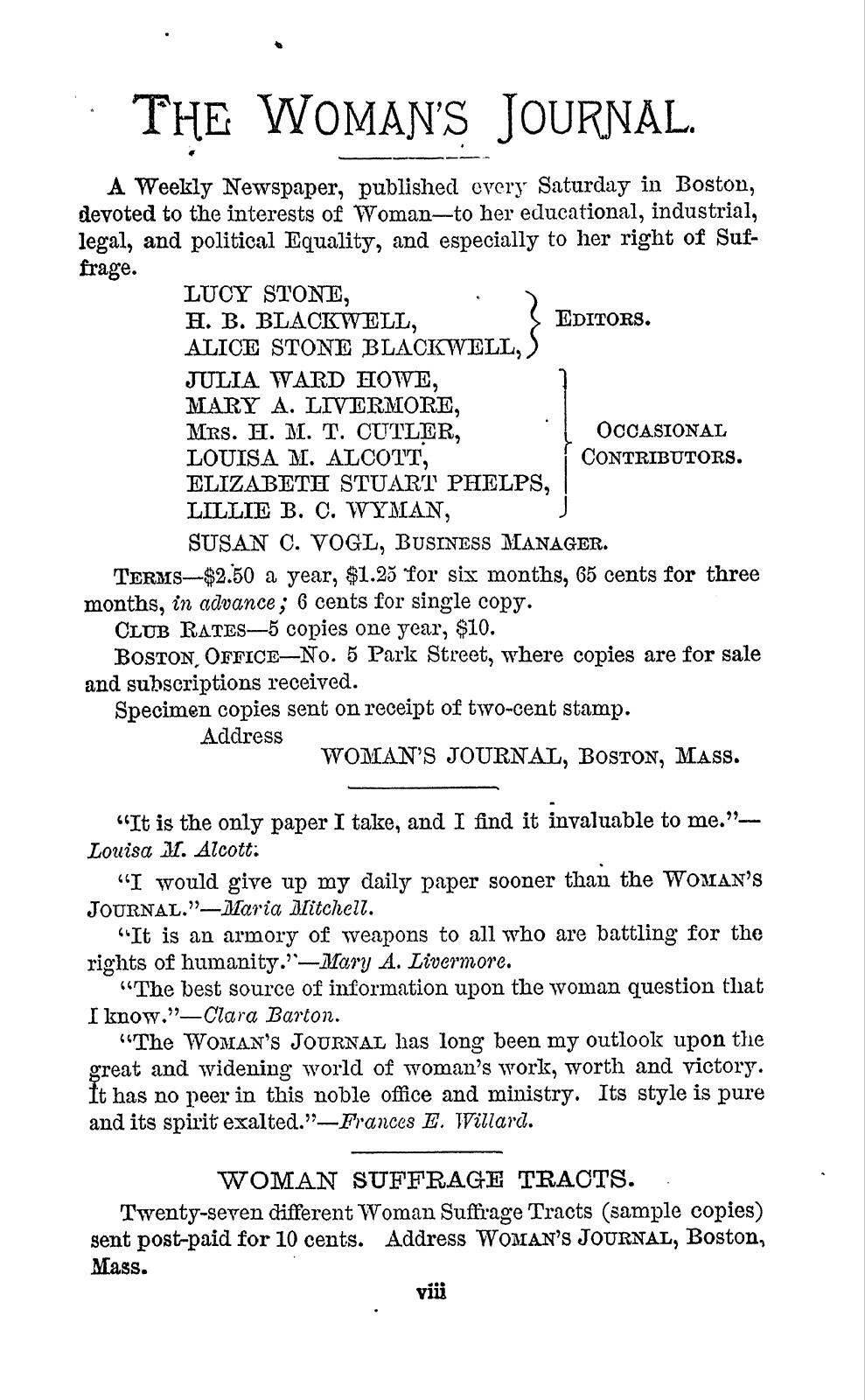
The advertisement on p.viii offers a newspaper and suffrage tracts alongside the cookbook’s domestic knowledge. These are asking prices for political publications.
$2.50
A year of The Woman’s Journal
Annual subscription advertised on p.viii; six months $1.25 and three months 65 cents.
6¢
One newspaper copy
The same advertisement offers five annual subscriptions for $10.
10¢
A packet of suffrage tracts
Sample copies of 27 different tracts, advertised postpaid.
Lucy Stone, H. B. Blackwell and Alice Stone Blackwell are named as editors. Mary A. Livermore and Julia Ward Howe appear among occasional contributors; Susan C. Vogl is the business manager. Culinary contribution, journalism and business organisation occupy the same printed network.
Editor and publisher: Hattie A. Burr, Boston. Inspected: original page image of p.viii in the MSU second-edition scan, naming 1886 and 1890 events. The advertisement has no separate date.
Interpretation & evidence limits
Interpretation: The book invited readers into a wider market for suffrage print and identified the people organising it.
Limit: These are newspaper and tract prices, not the cookbook’s selling price, sales receipts, printing costs or net donations. No cookbook financial result has been located.
A correction from the originals / Washington cookbook
Read dollars before counting books.
The 1922 movement history reports 3,000 copies published and sold (vol.VI,p.677). Williams’s accessible 2017 dissertation excerpt,p.91, instead reports 1,351 sold and a $333.31 shortfall after donations.
The original account changes that assessment. Eaton’s 10 January 1911 summary calls $1,351.01 the cost of 3,000 books and describes the $333.31 difference from sales receipts as covered by special donations. Neither entry is a count of books sold.
The original account supports neither 1,351 copies sold nor an uncovered $333.31 loss. It does not verify the 1922 assertion of 3,000 sold. The origin of the secondary excerpt’s mismatch is unknown; the exact Eaton document cited in its inaccessible bibliography has not been identified.
Stacy Jeanne Williams,Recipes for Resistance (UC San Diego PhD dissertation,2017),printed p.91: indexed university PDF excerpt only. Primary correction: Eaton, 10 January 1911,p.4, item 14748,MS 171,Box 2.
Original treasurer’s reports found / Washington / 1909–1911
The account behind the cookbook.
The original reports separate the cost of the batch from money received. They correct the financial reading while leaving unit sales open.
Eaton’s report through 30 November 1910 is explicitly marked not final. Its January 1911 update gives this cumulative cookbook statement:
$1,351.01
Stated cost of 3,000 books
A batch cost in historical US dollars. It is not a count of 1,351 copies sold.
$1,017.70
Receipts from sales
A dollar total. The report does not supply a matching count of copies sold.
$333.31
Gap covered by special donations
The source says covered. It does not describe this sum as an unpaid deficit still to be raised.
Sales receiptsDonations
The two amounts sum to the stated cost: $1,017.70 + $333.31 = $1,351.01. Bar lengths represent these reported dollar amounts, not books or political influence.
Cora Smith Eaton, Treasurer’s Report, from June 16th, 1909 to January 10, 1911, manuscript p.4, archive item 14748, identifier SL_devoe_000955.jpg. Washington State Library, Emma Smith DeVoe papers, WSL Manuscripts, MS 171, Box 2; digitised in Washington State Women’s History Consortium, collection devoe, parent item 14928 (Letters from Cora Smith Eaton). All five pages visually inspected. Open the original page image.
Follow the reports in date order
16 June 1909: the earlier report records cookbook sales receipts of $366.00. Original page / item 14744.
30 November 1910: the non-final report adds $635.70, giving $1,001.70 cumulative sales receipts. Its two sheets contain different cost totals; the figures are presented as recorded. Receipt sheet /14797 · Disbursement sheet /14798.
10 January 1911: current-period receipts are $651.70; with the earlier $366.00 they total $1,017.70. The p.4 summary gives cost $1,351.01 and a $333.31 gap covered by donations. p.1 /14745 · p.4 /14748 · p.5, attribution /14749.
What is resolved, and what remains open?
Resolved for this account: cost, sales receipts and the reported role of donations are distinct. The entry $1,351.01 is a cost; it supplies no evidence for 1,351 copies sold. The $333.31 is described as covered, rather than remaining an uncovered loss.
Still open: the 1922 history’s assertion that 3,000 copies were sold is not verified by these cash reports. A batch of 3,000 and receipts of $1,017.70 cannot establish unit sales without evidence of prices actually received, free distribution, credit and unsold stock. The November report has not been identified as the exact item cited as Eaton 1910 in Williams’s bibliography.
Interpretation: cookbook publishing required a combination of trading receipts and voluntary contributions. A political use for a book can coexist with sales that did not cover its stated cost.
Cookbook: title page (PDF 7), preface p. iii (PDF 9), contributor list p. iv (PDF 10), advertisement p. viii (PDF 14), recipe p. 5 (PDF 25), recipe p. 11 (PDF 31), and Howe’s statement p. 131 (PDF 151), visually checked in the Michigan State scan. The Iowa copy supplied searchable text for navigation; final cookbook references were checked against the Michigan State page images.
Institutional source:Constitution of the American Woman Suffrage Association and the History of Its Formation (Boston: George H. Ellis, 1881), officer list under p. 5. Consulted in the Library of Congress text PDF, page 4; not independently checked against an original page image. Its earlier list supplies associations, not evidence of office at cookbook publication.