Kitchen access / Three recipes / Copy catalogued 1899
Who could afford to cook?
The price beside a recipe is only a starting point.
Open the inventory behind each dish: the objects named, the heat and waiting, and the work described. These instructions establish material requirements, not the possessions, income or class of actual cooks.
The Book of Household Management, University of Leeds Library copy, Internet Archive b21536193; catalogued 1899, with a preface dated November 1888. The prices are the book’s estimates, not observed purchases or independently dated price surveys.
AI-generated contemporary illustrationBread, heat and the work behind a dish. A conceptual still life inspired by the kitchen-access questions; it does not reconstruct recipe 1731 or an identified household. Image provenance.
Select a recipe / Open its requirements
What had to be within reach?
Showing all three recipes.
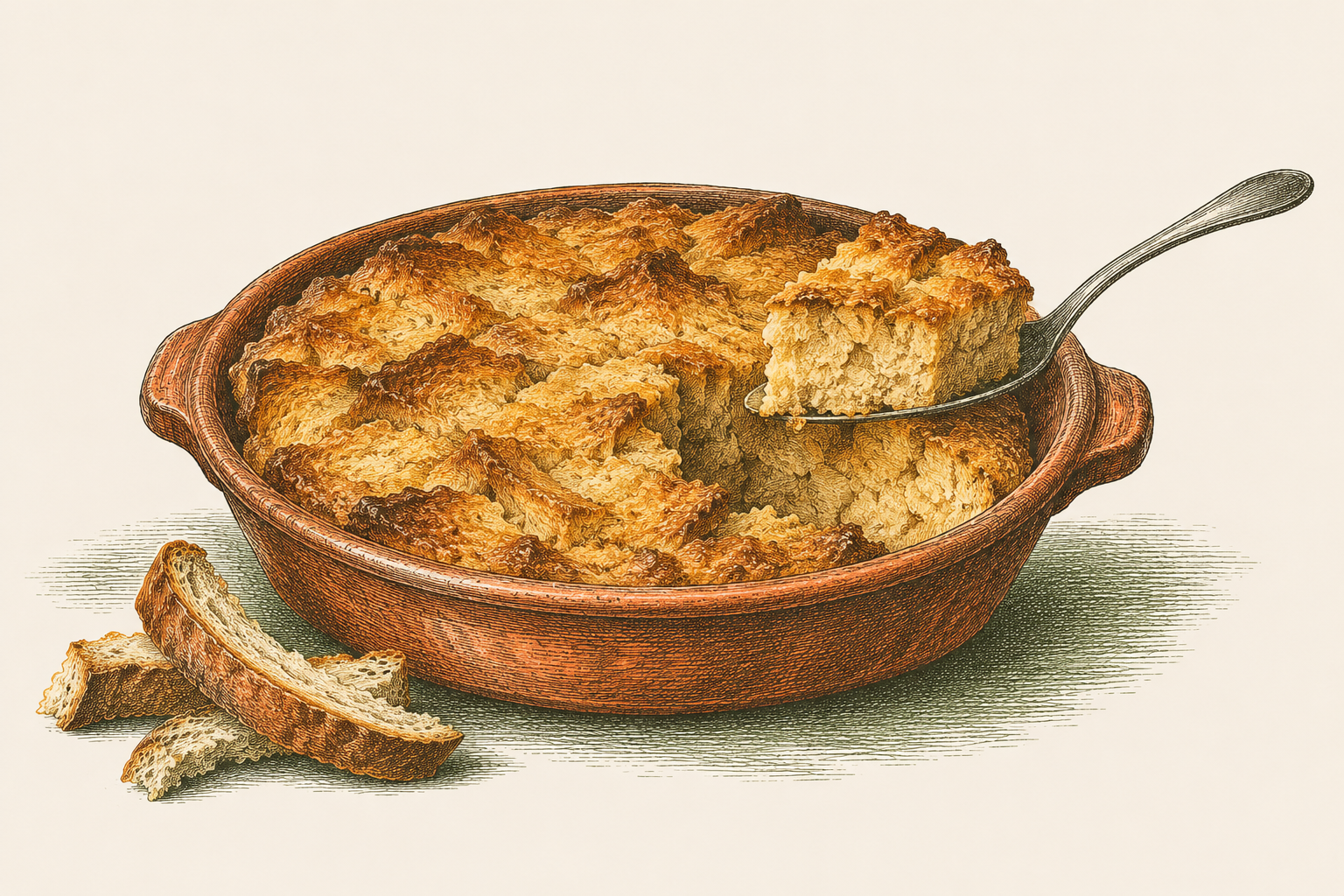
AI-generated interpretationAn imagined serving of plain bread pudding; appearance and vessel are interpretive. About these images.
No. 1731 / Printed p. 824
Very Plain Bread Pudding
6d., exclusive of the bread.
Sufficient for 6 or 7 persons.
Printed estimate; the accounting boundary is not fully itemised.
Equipment named
Explicit in method
Fork, spoon, pie-dish and moderate oven.
Heat and waiting
Method plus stated baking time
Boiling water; cooling before pressing and mixing; 1½ hours baking. Fuel type and quantity are not given.
Work
Method; total labour unknown
Break, soak, press, mash, measure, mix and bake. No measured total preparation or cleaning time.
A choice within the recipe
Optional substitution
Milk may replace the water as an improvement. Its additional price is not supplied.
What the price cannot tell us
Sixpence is an incomplete dish cost: bread is explicitly excluded. Do not label it free food, a complete meal, or an observed purchase. The printed estimate does not separately identify fuel, equipment or labour charges.
Class unassigned. Economy and reuse are explicit; the actual consumer’s occupation, income and social position are unknown.
Inspect the source page
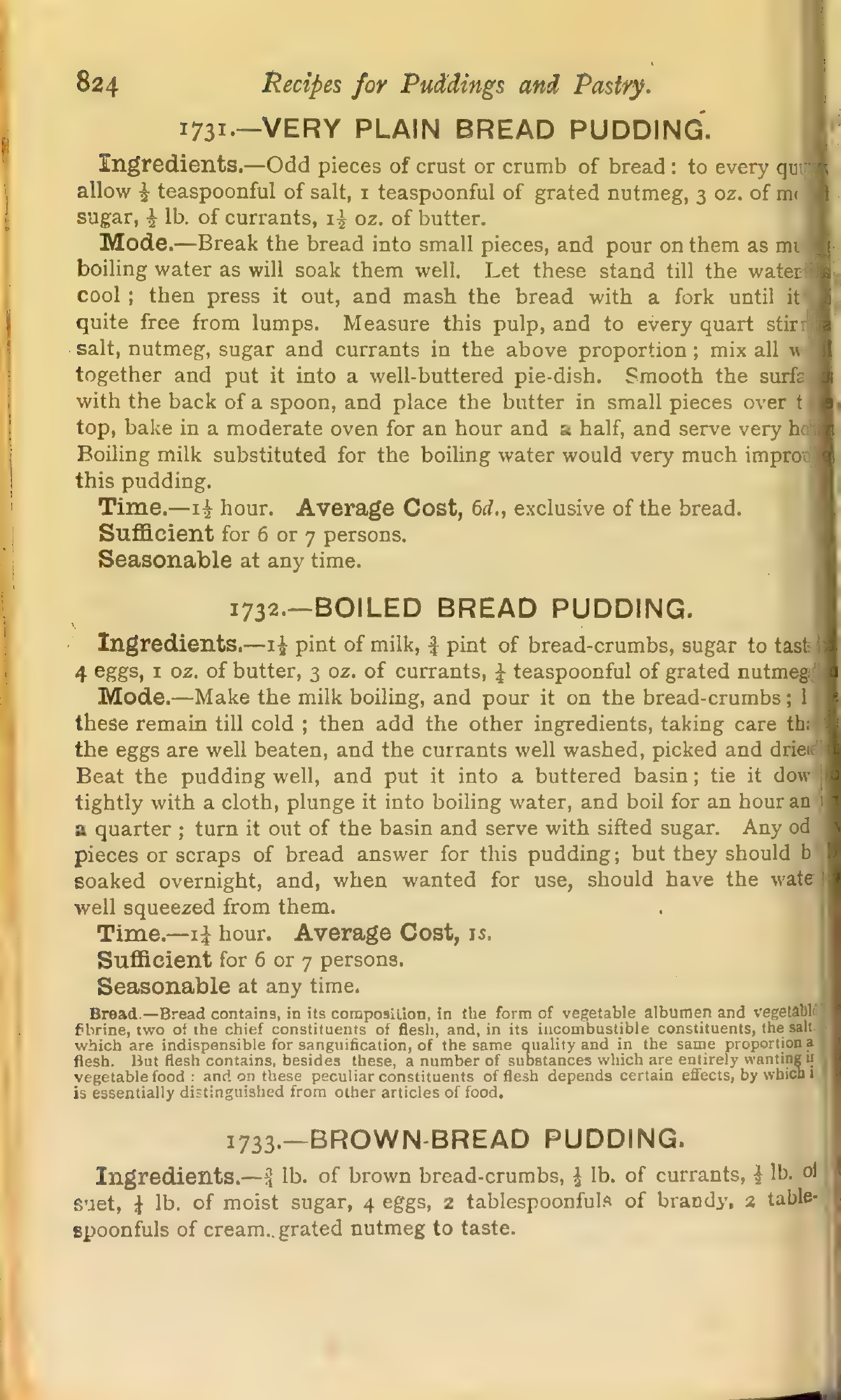
Recipe number, page, fractions, 90-minute baking time, yield and cost qualification checked against the scan. The right outer margin is faded/cropped. Bracketed words are editorial reconstructions, not fully legible readings; retain them until a clearer image of this edition is found.
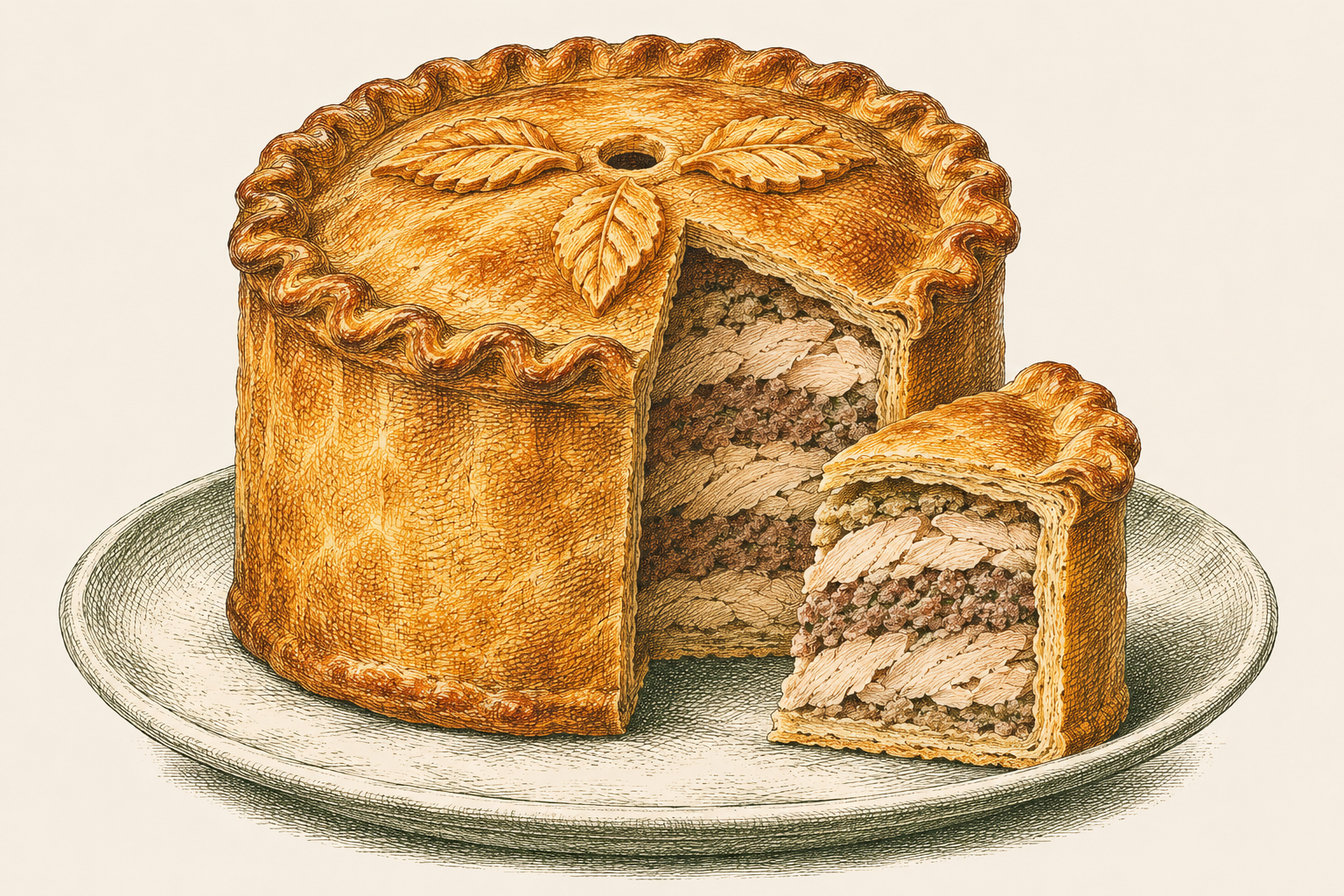
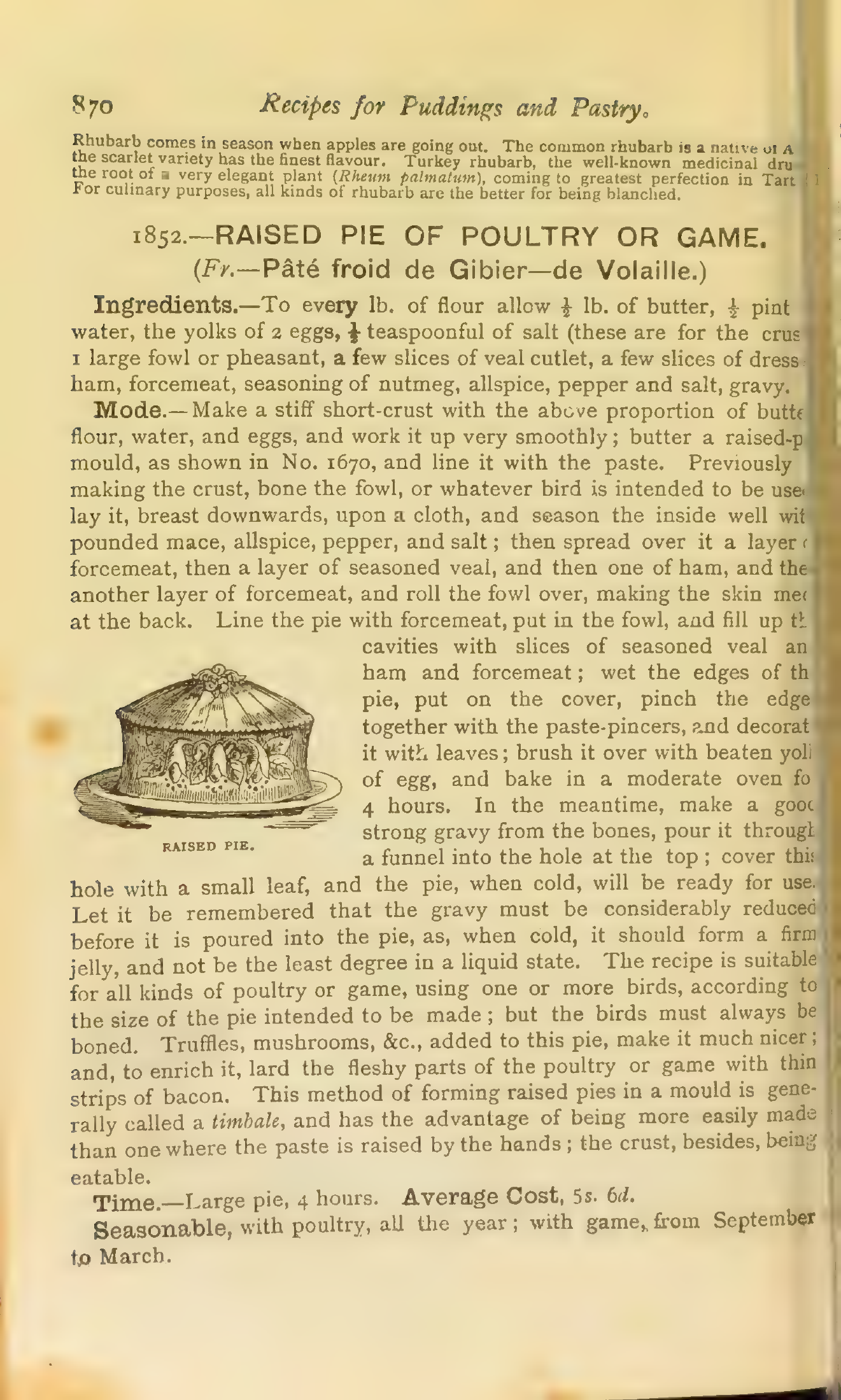
AI-generated interpretationAn imagined raised pie; its exact decoration, proportions and layering are not established by the text. About these images.
No. 1852 / Printed p. 870
Raised Pie of Poultry or Game
5s. 6d.
No fixed number of diners is given; the recipe allows one or more birds according to pie size.
Printed estimate; the accounting boundary is not fully itemised.
Equipment named
Explicit in method
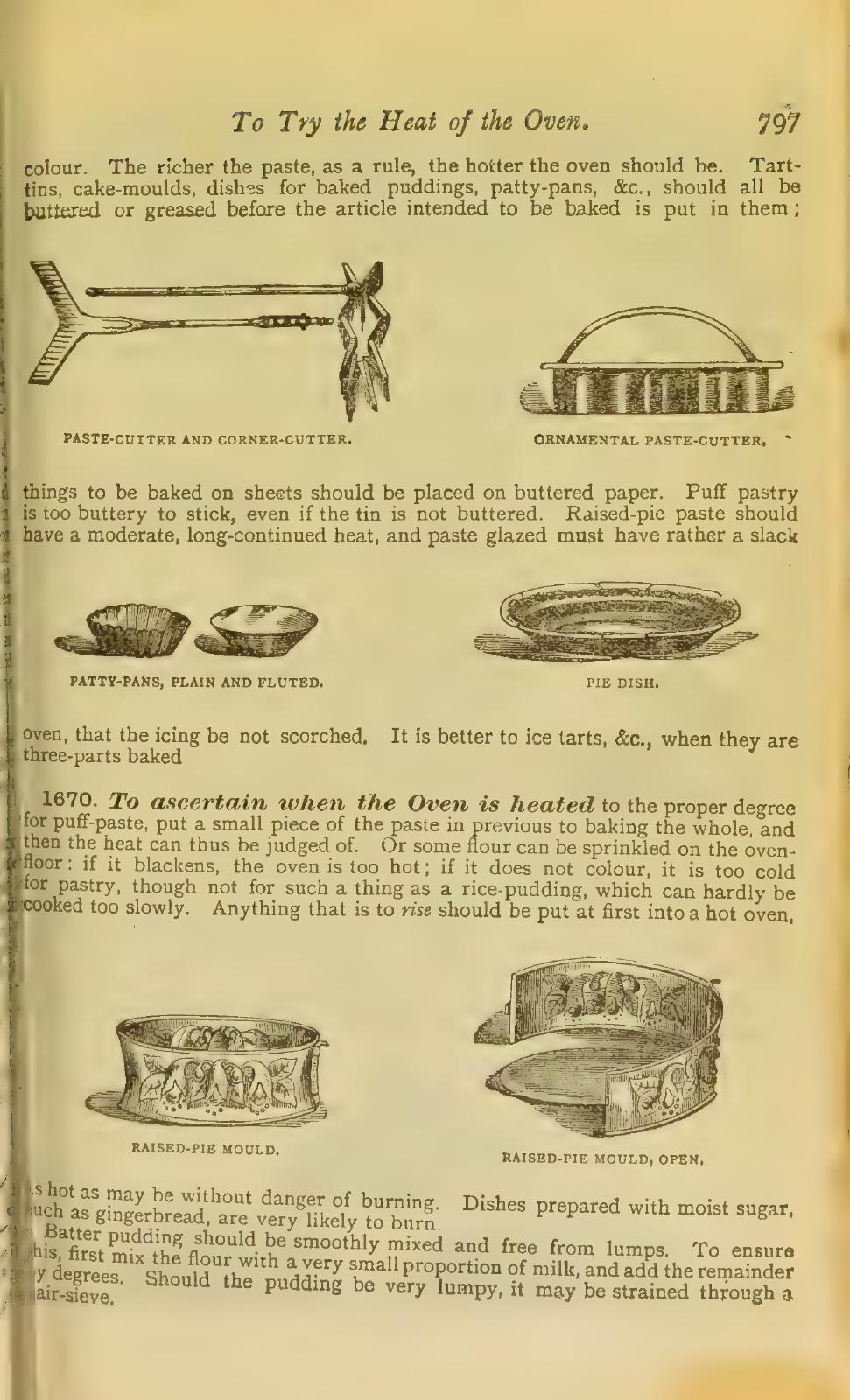
Raised-pie mould, cloth, paste-pincers, funnel and moderate oven. The mould is illustrated assembled and open on p.797, below paragraph 1670.
Heat and waiting
Method; not total elapsed time
Four hours baking for a large pie; gravy is made in the meantime; the pie is used cold. Cooling time and fuel consumption are unknown.
Work
Method; worker unidentified
Bone the bird, make pastry, layer meats and forcemeat, decorate, reduce gravy and fill the pie. These processes cannot be converted into paid hours from this text.
A choice within the recipe
Optional additions; variable scale
Truffles, mushrooms and bacon are optional enrichments. Bird numbers vary with pie size.
What the price cannot tell us
5s. 6d. equals 66 old pence. Bird number and pie size can vary; no defensible per-person price is available. The book does not itemise the cost of optional enrichments, utensils, fuel or labour here.
Possible association with resource-intensive entertaining is a curatorial hypothesis. Actual class and household income remain unassigned.
Inspect the source page
Recipe number, p. 870, crust ratios, 4 hours and 5s. 6d. checked against scan. Brackets restore faded/cropped outer-margin words. Nutmeg appears in the ingredient list, mace in the method: the discrepancy is preserved. No quantity is supplied for forcemeat or gravy. The reference points to printed p.797: two illustrations below paragraph 1670 show the raised-pie mould assembled and open. Paragraph 1670 itself concerns testing oven heat; it is not a mould-making instruction. Page image checked 5 November 2026.
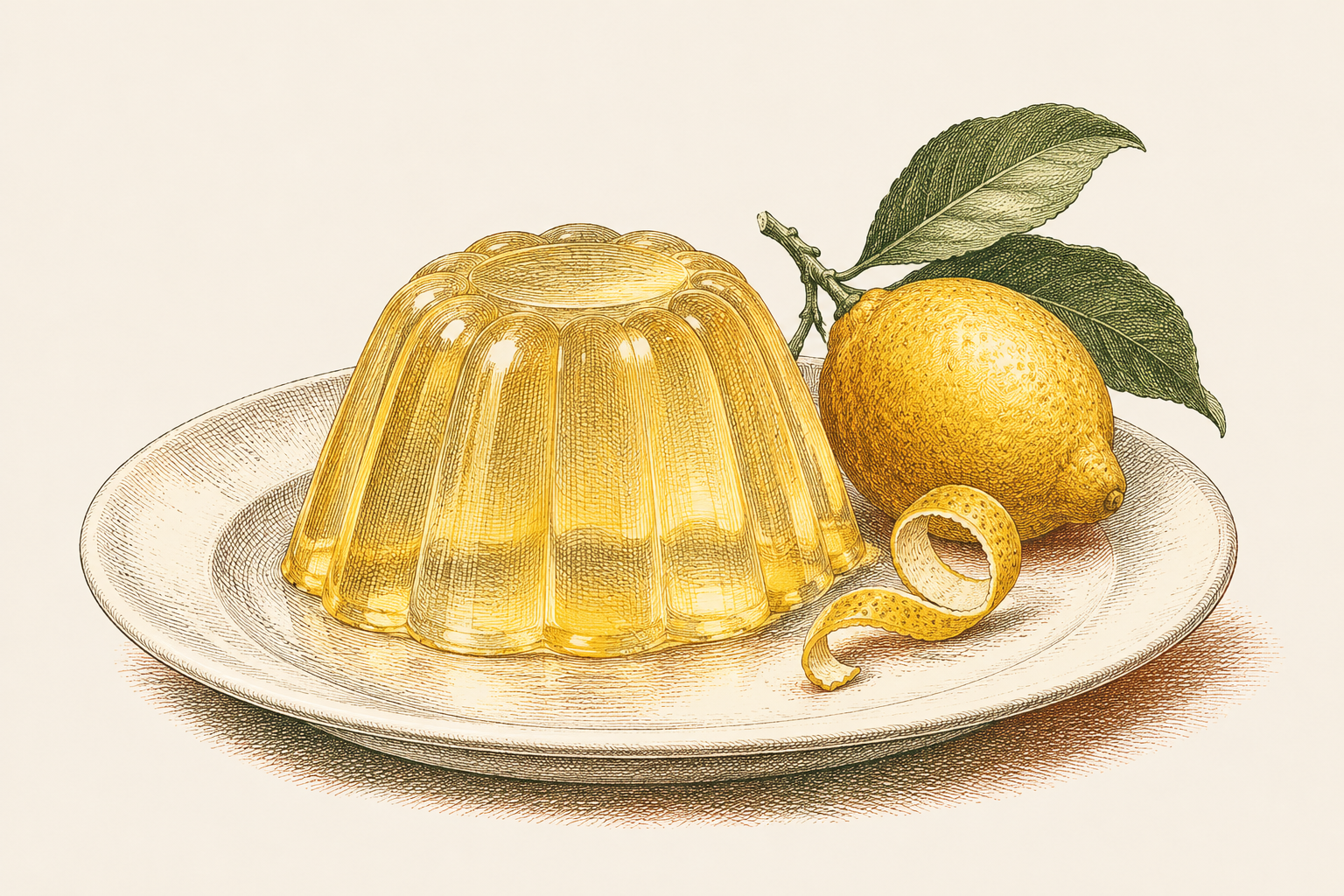
AI-generated interpretationAn imagined moulded lemon jelly; the mould shape and presentation are interpretive. About these images.
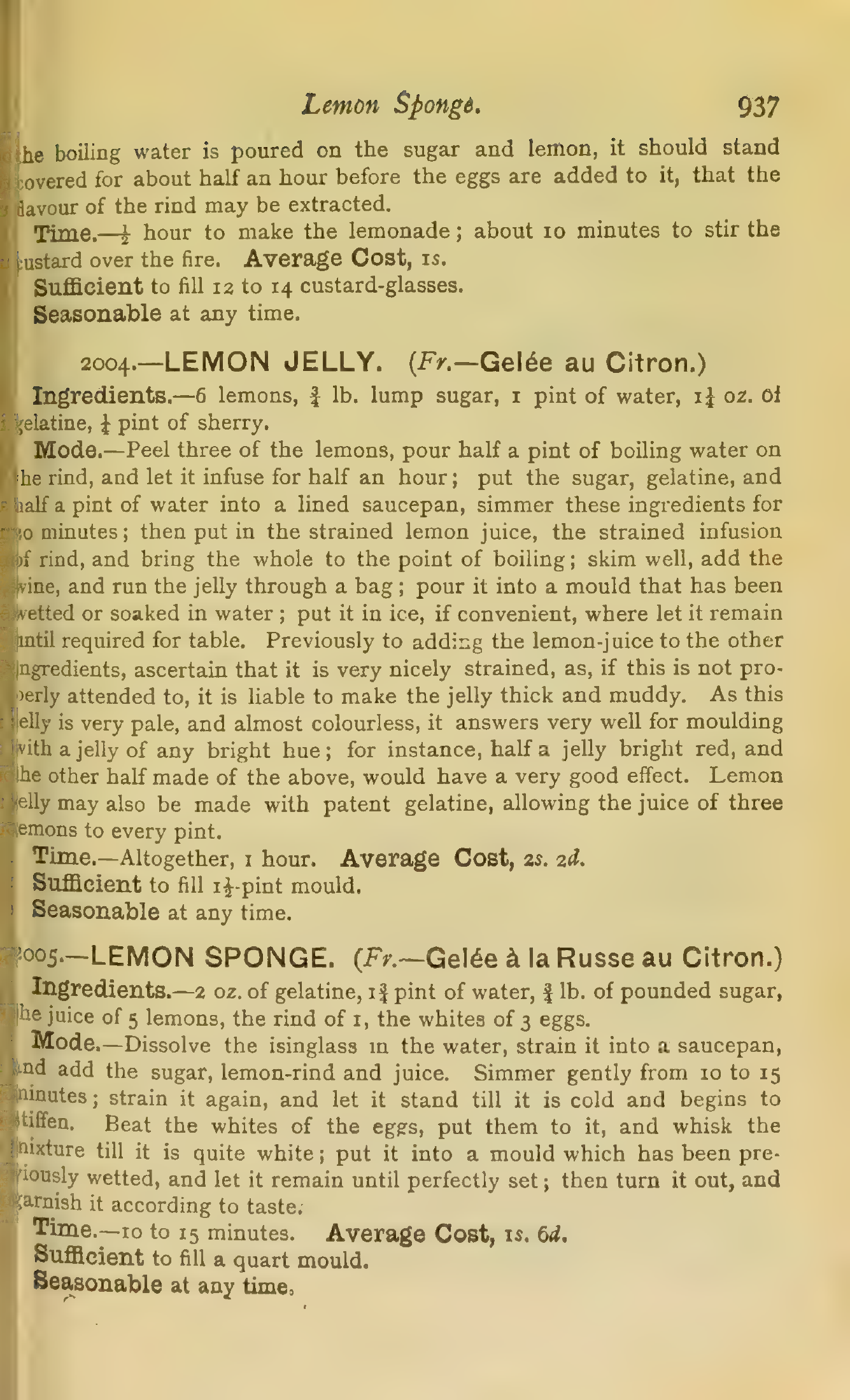
No. 2004 / Printed p. 937
Lemon Jelly
2s. 2d.
Sufficient to fill 1½-pint mould.
Printed estimate; the accounting boundary is not fully itemised.
Equipment named
Explicit in method and yield
Lined saucepan, filtering bag and mould. The yield specifies a 1½-pint mould; its material is not stated.
Heat and waiting
Printed timing; setting unknown
Half-hour infusion and ten-minute simmer appear in the method. The printed time is one hour altogether, but the mould is left until required. A reliable setting time is not established.
Work
Explicit method and presentation aim
Peel, infuse, strain, skim, filter and mould. Repeated filtering serves the stated aim of clarity.
A choice within the recipe
Conditional cooling instruction
Ice is suggested if convenient. It is optional; an ice-house or ice purchase cannot be inferred.
What the price cannot tell us
2s. 2d. equals 26 old pence for the recipe’s mould yield. No per-person price can be calculated without an assumed portion size. Ice is optional; possession of an ice-house cannot be inferred.
Decorative presentation is explicit; an exclusive upper-class association is not established. Actual consumers and income are unknown.
Inspect the source page
Recipe number, printed p. 937, all quantities, 1 hour, 2s. 2d. and 1½-pint mould checked against scan. The digital page-number index omits this page label; the printed page number is visible on the scan. No diners count is given. Patent-gelatine alternative is preserved without treating it as a fully specified second recipe.
Our proposition: studying the resources specified in a recipe can expose forms of access that its quoted dish price does not measure. The book provides evidence for this question; it does not tell us which household actually owned the tools or supplied the labour.
The displayed estimates retain the book’s own units and qualifications. Fuel costs, total labour, portion sizes and the income of actual consumers are not established by the recipes.
What would support an affordability claim?
A dated household account, menu or diary establishing actual preparation or consumption.
Income and living resources for that household, in the same place and period.
Local ingredient and fuel prices, plus a clear distinction between reusable purchases and costs per dish.
Evidence of staffing and work, including tasks absent from the recipe’s time line.
Recipes 1731 (p.824), 1852 (p.870) and 2004 (p.937), Internet Archive b21536193. Equipment, timings, cost qualifications and yield statements rechecked against the supplied scans on 2 November 2026. The first two pages have faded or cropped margins; uncertain reconstructions remain disclosed in the source notes. Inventory entries are modern summaries, not full transcriptions.
The Recipe Cabinet remains a separate project; its source findings have been updated alongside this exhibition. These three source-page copies are included here so this website can be uploaded independently. Source item: University of Leeds Library, Internet Archive record, previously recorded with Public Domain Mark.
Historical page image, not an AI illustration. Beeton, consulted copy catalogued 1899, printed p.797. Inspect the source page.
One utensil, two views
The reference points to printed p.797: two illustrations below paragraph 1670 show the raised-pie mould assembled and open. Paragraph 1670 itself concerns testing oven heat; it is not a mould-making instruction.
Recipe 1852 sends the reader here before lining the mould with pastry. The book thus supplies both an instruction and a picture of the equipment it assumes.
Interpretation & evidence limits
Interpretation: An illustrated cross-reference makes the material requirements of culinary display visible.
Limit: Neither page identifies an actual owner, a manufacturer, a material or a price.